How To Start And Manage A TFSA In South Africa
A Tax-Free Savings Account is one of the most powerful investment tools available to South Africans. The basic mechanics are simple: you contribute money (which has already been taxed), and everything inside the account grows free of income tax, dividends tax, and capital gains tax.
Getting started can feel overwhelming - there are multiple providers, different account types, and a set of rules that can cost you if you get them wrong.
This guide covers the practical steps: choosing a provider, deciding what to buy inside the account, setting up contributions and keeping yourself on the right side of the SARS limits.
Choose A Provider
Your first decision is where to open the account. Not all TFSA providers are the same.
The main options fall into a few categories:
Self-directed online brokers
These give you direct control over what you buy. You open an account, deposit money, and choose from a range of ETFs and shares. Fees are typically low, and there are no ongoing advice or administration charges beyond transaction costs and the ETF's TER.
Popular options include EasyEquities, Sygnia, and Standard Bank WebTrader. EasyEquities is the most accessible for new investors - no monthly fees, low brokerage, and a straightforward TFSA application process.
Unit trust platforms (LISPs)
Linked Investment Service Providers offer a range of unit trust funds from multiple asset managers. You get access to professional fund managers who decide what to buy. The trade-off is higher fees - typically 1% to 1.5% in total annual costs, sometimes more.
Bank savings accounts
Most major banks offer a TFSA that functions like a savings or money market account. These are the simplest option but also the least effective for long-term growth. The interest rates are low relative to equity returns, and over 20 or 30 years the difference between a bank TFSA and an ETF-based TFSA can be hundreds of thousands of rands.
The Clear Winner
A TFSA doesn't have to be a savings account. It can work extremely well as an investment account provided you pick right and hold tight.
If you treat it like a savings account, you leave most of its potential on the table and will be fighting with inflation just to break even.
A very good platform to use is EasyEquities, due to the low cost and wide variety of investment options available.

Pick What To Buy
Once you have an account, you need to decide what to invest in. For most investors, the simplest approach is the most effective: buy a low-cost, diversified ETF and keep holding (and buying it provided you have not hit the contribution limit).
The core building blocks for a South African TFSA are:
- A Global equity ETF - tracks developed-market shares (for example an MSCI World or S&P 500 index ETFs). This gives you exposure to the largest companies in the world.
- A South African equity ETF - tracks the local market (for example the JSE Top 40 or SWIX 40 index ETFs). This gives you local exposure and dividend income.
- A South African bond ETF - tracks the local bond market (for example the South African or Namibian Government bond ETFs). This gives you exposure to the reliability and consistency of the bond market.
It is very important to ensure that the fees - the TIC (Total Investment Cost) is kept low as this can have large and compounding impacts on your returns in the long run. See more in the fees blog post.
You can hold many different ETFs inside the same TFSA. The right split depends on your goals and risk tolerance. Do not pick too many though - many ETFs are closely correlated which means they will move together - so it if often best to pick the best among the closely correlated etfs, TFSALabs tools can help with that. The ETF compare, Strategy Builder and Portfolio strategy compare tools can be used to pick the right mix.
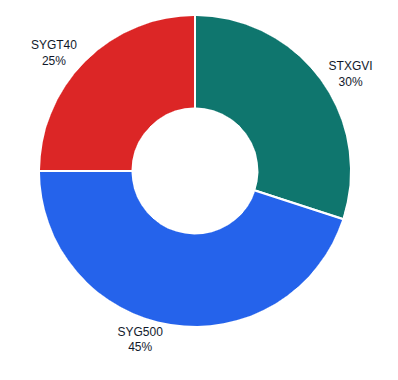
Use the TFSA ETF list to browse all available options with their performance metrics.
Set Up Contributions
The annual TFSA limit is R46,000 per person (from the 2026/27 tax year), with a lifetime limit of R500,000. You can contribute in a lump sum at the start of the tax year (1 March) or spread the amount across monthly contributions.
Monthly contributions have a practical advantage: they smooth out market volatility and make it easier to budget. But the annual-upfront approach has historically produced slightly higher returns because the money is invested for longer.
Set up a recurring payment from your bank account to your TFSA on the same day each month. Automating the contribution removes the temptation to skip a month. Alternatively, deposit the lump sum on the 1st of March every year until the contributions are maxed out.
Simple tips
Consolidate your accounts
You can have more than one TFSA, but the annual and lifetime limits are shared across all of them. This is where many investors get into trouble.
If you have two TFSAs at different providers and contribute R30,000 to each, you have contributed R60,000 in total - R14,000 over the annual limit. The penalty for exceeding the limit is 40% of the excess.
The simplest way to avoid this is to use a single TFSA account. If you already have multiple accounts, consider transferring them into one provider rather than withdrawing and re-contributing. A proper transfer between TFSA providers does not count as a new contribution.
Track your contributions
It is your responsibility to stay within the annual and lifetime limits. The provider will not stop you from over-contributing.
Keep a simple record of every deposit you make into your TFSA, across all providers. At the end of each tax year (28 February), check that your total contributions for the year are within the limit.
The lifetime limit of R500,000 is cumulative. If you have been contributing the maximum since 2015, you will approach this limit in the next few years. Once you hit it, no further contributions are allowed - but the money already inside can continue growing tax-free.
Avoid withdrawals
Withdrawals from a TFSA do not restore your contribution limit. If you withdraw R50,000 and later try to put it back, SARS treats the replacement as a new contribution.
This means that withdrawing money permanently reduces the amount you can keep sheltered inside the TFSA system. Unless you have an emergency, leave the money alone and let the tax-free compounding work.
Also read: How A 1% Fee Difference Can Cost You A Fortune Over 40 Years - why low-cost ETFs make a massive difference over time.
Try the tools behind this article
Create a free account to compare ETFs, explore the efficient frontier, and test optimal strategies with your own data - no credit card required.
Create free account